

Sale
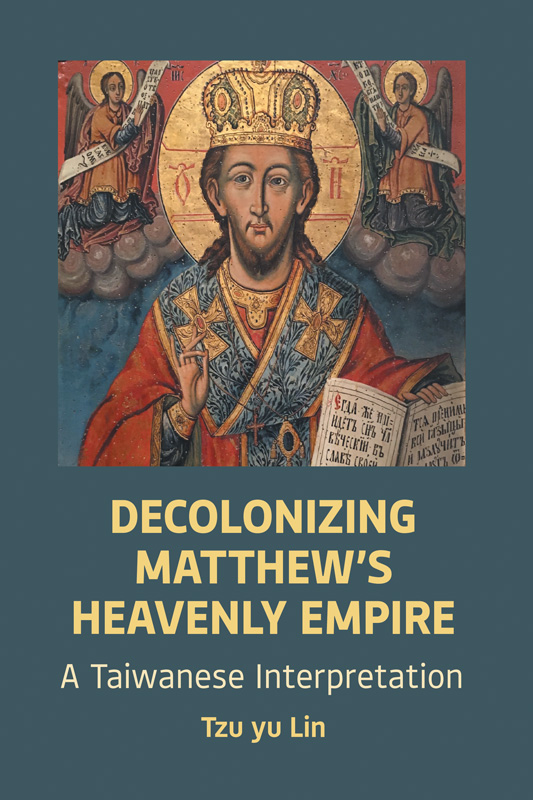
Decolonizing Matthew’s Heavenly Empire: A Taiwanese Interpretation
Published: Nov 2026
Original price was: £78.00.£36.00Current price is: £36.00.
What happens when the ‘Good News’ announces an empire? Tzu yu Lin’s monograph rereads the Gospel of Matthew by translating ἡ βασιλεία τῶν οὐρανῶν as the ‘Heavenly Empire’ and taking its imperial language seriously. It examines the infancy narrative, the parables of Matthew 13, the Last Judgment, the mountain sermons, and the Great Commission in order to place the Heavenly Empire itself at the center of imperial critique. These readings follow how Matthew presents the Heavenly Empire’s claims over all peoples and how those claims shape the Gospel’s vision of salvation.
Drawing on decolonial theory, the book approaches Matthew through questions of modernity/coloniality and the imperial power carried by promises of salvation. A Taiwanese context provides one lens for recognizing how domination can be justified through promises of unity and well-being. This context also brings non-Western imperialism into the discussion and offers a different angle from readings centered primarily on Rome or Western imperial power.
At the center of the book is the claim that Matthew’s liberationist Good News and the Heavenly Empire’s imperial project are ‘two sides of the same coin’. The rhetoric of salvation gives this imperial project its justification and moral force, allowing the Heavenly Empire to present its expansion as Good News for all peoples. Reading these two dimensions together changes how familiar Matthean texts appear and directs attention to the coloniality carried within the Gospel’s promise of salvation. The monograph therefore identifies the darker side of the Good News as coloniality itself.
Sale
Decolonizing Matthew’s Heavenly Empire: A Taiwanese Interpretation
Original price was: £78.00.£36.00Current price is: £36.00.
What happens when the ‘Good News’ announces an empire? Tzu yu Lin’s monograph rereads the Gospel of Matthew by translating ἡ βασιλεία τῶν οὐρανῶν as the ‘Heavenly Empire’ and taking its imperial language seriously. It examines the infancy narrative, the parables of Matthew 13, the Last Judgment, the mountain sermons, and the Great Commission in order to place the Heavenly Empire itself at the center of imperial critique. These readings follow how Matthew presents the Heavenly Empire’s claims over all peoples and how those claims shape the Gospel’s vision of salvation.
Drawing on decolonial theory, the book approaches Matthew through questions of modernity/coloniality and the imperial power carried by promises of salvation. A Taiwanese context provides one lens for recognizing how domination can be justified through promises of unity and well-being. This context also brings non-Western imperialism into the discussion and offers a different angle from readings centered primarily on Rome or Western imperial power.
At the center of the book is the claim that Matthew’s liberationist Good News and the Heavenly Empire’s imperial project are ‘two sides of the same coin’. The rhetoric of salvation gives this imperial project its justification and moral force, allowing the Heavenly Empire to present its expansion as Good News for all peoples. Reading these two dimensions together changes how familiar Matthean texts appear and directs attention to the coloniality carried within the Gospel’s promise of salvation. The monograph therefore identifies the darker side of the Good News as coloniality itself.